01 / Compare
Two products for the same purpose
Solid soap and shower gel serve the same purpose: washing. What changes is the shape and what is in the product. This article compares, without bias, what can be observed: the shape, the ingredients, the use and the storage.
The shape changes the use
A soap comes as a solid bar. You wet it, work it into a lather in your hands or on a washcloth, and rinse. A shower gel is a liquid, which you pour from a bottle. The routine is almost the same, but the soap needs somewhere to rest between uses.
A composition to read
A solid soap is the result of transforming fats with a base: this is called saponification. A shower gel is most often a water base containing washing agents, to which fragrances and preservatives are added. Rather than relying on a word on the packaging, the most reliable approach is to read the list of ingredients.
02 / Read
Reading the ingredient list of a soap
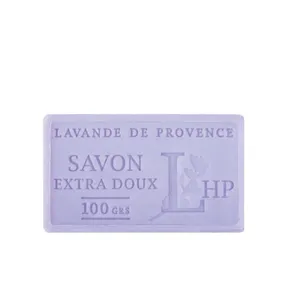
The INCI list (International Nomenclature of Cosmetic Ingredients) must list ingredients in descending order of concentration by weight, but only up to a certain point: those that represent less than 1% may be listed in any order, and colourants may be grouped at the end of the list. Take our 100 g lavender soap: it begins with sodium palmate and sodium palm kernelate, which are the soap bases, then aqua (water), lavandin oil (lavandula hybrida oil) and glycerin (glycerin). Then come salt, two sequestering agents (tetra sodium etidronate and tetra sodium edta), colourants (the “CI”), a washing agent (sodium laureth sulfate), a preservative (phenoxyethanol) and fragrance components that must be declared, such as linalool, limonene and geraniol.
For the sake of transparency: this washing agent and this preservative are also found in many shower gels. Solid soap therefore does not mean a totally different composition; the ingredient list of each product is what tells you.
An ingredient that changes from one soap to another
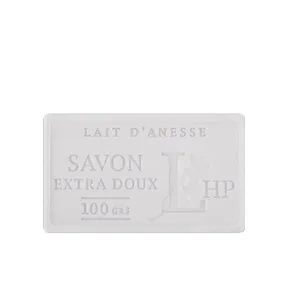
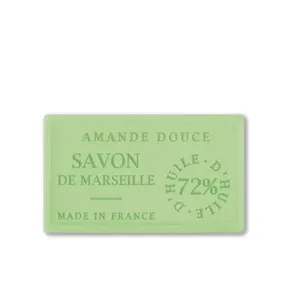
Each soap highlights an ingredient. In the sweet almond soap, it is sweet almond oil (Prunus amygdalus dulcis oil); in the donkey milk soap, donkey milk (donkey milk); in the argan oil one, argan oil (Argania spinosa kernel oil). The page of each soap gives the full list.
“Superfatted”, a word to decode
Several of our soaps are described as superfatted: they are made with more fat than is needed to obtain the soap. It is an indication about the manufacture, not a promise about the skin.
03 / Choose
Using a solid soap well
Making your soap last
The weak point of a soap is the water that collects underneath. Placing it on a soap dish, which keeps it dry between uses, extends its life. Stored in a dry place, it keeps longer.
A few precautions
According to their pages, our soaps must not be swallowed and are kept out of the reach of children. Some pages ask you to stop using the soap in case of irritation, others point out a risk of skin allergy: read the one for the soap you choose.
So, soap or shower gel?
It is not a question of a good or bad product: it is a question of habits. If you like the ritual of a bar of soap, the lather in your hands, a simple scent and a bar that you put away on a soap dish, solid soap suits you. If you prefer a liquid that you pour out, shower gel remains more practical.
04 / Continue
Going further
Find our 100 g soaps in the Bath & care collection.